
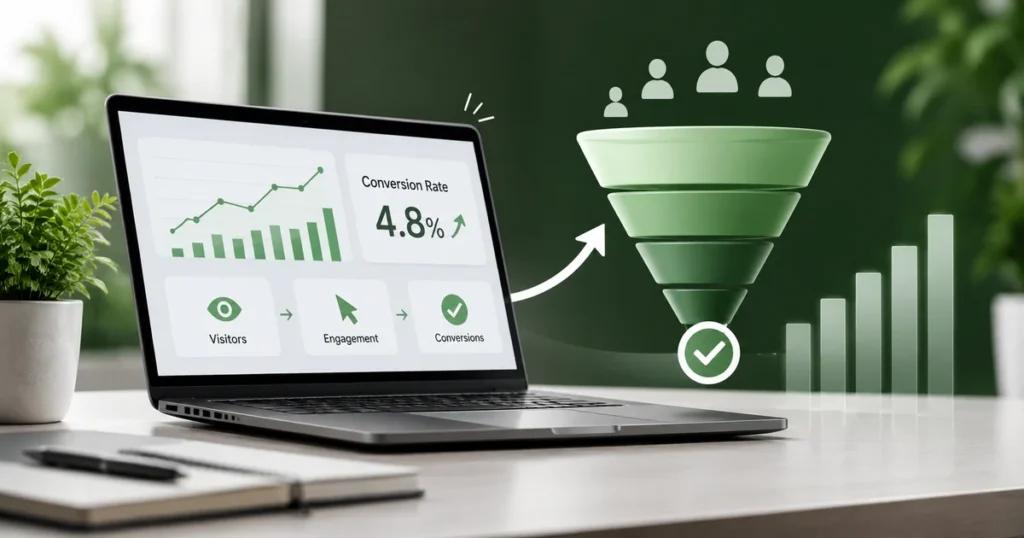
Getting visitors to your website is only one part of growing your business online. What happens after they arrive is equally important.
Some visitors may explore your services, read your content and leave without contacting you. Others may be interested in your business but struggle to find the information they need or understand what to do next.
This is where Conversion Rate Optimization (CRO) becomes important.
CRO focuses on improving your website experience so that more visitors take meaningful actions, such as submitting an enquiry, requesting a quote, booking a consultation or making a purchase.
In this guide, we will explore what CRO means, why websites fail to convert visitors and how businesses can improve website conversions through practical design and marketing strategies.
What Is Conversion Rate Optimization (CRO)?
Conversion Rate Optimization is the process of improving a website or landing page to increase the percentage of visitors who complete a desired action.
A conversion does not always mean a purchase. Depending on your business goals, it could include:
- Submitting a contact or enquiry form
- Requesting a quotation
- Booking a consultation
- Calling your business
- Signing up for a newsletter
- Purchasing a product or service
The conversion rate is commonly calculated using this formula:
Conversion Rate = (Number of Conversions ÷ Total Visitors) × 100
For example, if a website receives 1,000 visitors and 30 of them submit an enquiry, its visitor-based conversion rate is 3%.
The important point is that CRO is not simply about attracting more traffic. It is about making your existing website traffic more valuable.
Why Website Traffic Alone Is Not Enough
A website can receive considerable traffic without generating enough business enquiries or sales.
This can happen when visitors:
- Cannot understand what the business offers.
- Do not find relevant information quickly.
- Struggle to navigate the website.
- Encounter confusing or unclear calls to action.
- Lose trust because essential business information is missing.
- Experience slow loading or poor mobile usability.
- Find the enquiry process unnecessarily complicated.
Increasing traffic without addressing these problems may not improve business results. A more effective approach is to understand visitor behaviour, identify obstacles and improve the website experience.
Common Reasons Websites Fail to Convert Visitors
Unclear Website Messaging
Visitors should quickly understand what your business offers, who your services are for and how you can help. A vague headline or generic description can make it difficult for potential customers to recognise whether your business meets their needs.
How to improve it:
- Use clear and specific headlines.
- Explain your services in simple language.
- Highlight the problems your business solves.
- Communicate your value without exaggerated claims.
Weak or Confusing Calls to Action
A Call to Action (CTA) tells visitors what they should do next. If buttons are difficult to notice or use unclear wording, visitors may not take the next step.
How to improve it: Use action-oriented CTA text such as Request a Quote, Book a Consultation, Discuss Your Project or Contact Our Team. Place relevant CTAs where visitors naturally need them, without overwhelming the page with too many competing actions.
Poor Website User Experience
A confusing layout, inconsistent navigation or difficult-to-read content can discourage visitors from exploring your website.
How to improve it:
- Organise information with a clear visual hierarchy.
- Keep navigation simple and predictable.
- Use readable typography and appropriate spacing.
- Make important information easy to find.
- Maintain consistent design patterns across pages.
A Complicated Enquiry Process
Every unnecessary step in an enquiry process can create another opportunity for visitors to abandon it. Long forms, unclear field labels and unnecessary information requests can make contacting your business feel difficult.
How to improve it:
- Ask only for essential information.
- Use clear field labels.
- Make forms easy to complete on mobile devices.
- Provide useful confirmation messages.
- Explain what happens after submitting an enquiry.
Missing Trust Signals
Potential customers often need reassurance before contacting a business or making a purchase. A website that does not communicate credibility may leave visitors uncertain.
How to improve it:
- Use real client testimonials with permission.
- Show verified project examples and case studies.
- Provide clear business contact information.
- Display relevant certifications or professional credentials.
- Explain services and processes transparently.
Never use fabricated testimonials, unsupported performance claims or misleading credentials.
Poor Mobile Experience
Many visitors access business websites through smartphones. A page that works well on desktop may still create problems on smaller screens. Common issues include oversized text, overlapping elements, difficult-to-tap buttons and forms that are uncomfortable to complete.
How to improve it:
- Use responsive layouts.
- Ensure buttons and links are easy to tap.
- Keep text readable without unnecessary zooming.
- Avoid horizontal scrolling.
- Optimise images and page loading performance.
- Test forms and navigation on different screen sizes.
Slow Website Performance
Visitors may leave when a website takes too long to load or respond. Large images, unnecessary scripts, excessive animations and poorly optimised resources can affect website performance.
How to improve it:
- Compress and properly size images.
- Use modern image formats such as WebP where suitable.
- Reduce unnecessary scripts and third-party resources.
- Implement appropriate caching.
- Monitor Core Web Vitals.
- Review performance on both mobile and desktop.
How Website Design and UX Influence Conversions
Website design is not only about appearance. It also influences how visitors understand information and make decisions.
A conversion-focused website should provide:
- Clear visual hierarchy: Important messages, service details and actions should be easy to identify.
- Consistent navigation: Visitors should be able to move between relevant pages without confusion.
- Relevant content: Each page should answer the questions visitors are likely to have before taking action.
- Visible CTAs: Important actions should be easy to find and understand.
- Accessible interactions: Forms, buttons, links and navigation should work for different users and devices.
The goal is to reduce friction and make the next step clear.
How to Measure Website Conversion Performance
CRO decisions should be based on meaningful data rather than assumptions. Some useful metrics include:
- Conversion Rate: The percentage of visitors who complete a desired action.
- Form Submission Rate: The proportion of relevant visitors who successfully submit a form.
- CTA Clicks: The number of visitors interacting with important calls to action.
- Qualified Leads: Enquiries that match your business’s target customer requirements.
- Cost Per Lead: The marketing cost associated with generating a lead.
- Landing Page Performance: How effectively a landing page supports its intended goal.
Tools such as Google Analytics 4 and Google Tag Manager can help measure website interactions and conversions when configured correctly.
For meaningful analysis, define what counts as a conversion before collecting data. For example, a button click and a successfully submitted enquiry form are different actions and should not automatically be treated as the same result.
Practical CRO Improvements for Small Businesses
Small businesses do not always need a complete website redesign to improve conversions. Start with practical improvements:
- Review your homepage headline and make your main offering clear.
- Check whether visitors can easily find your services and contact details.
- Improve the visibility and wording of important CTAs.
- Simplify enquiry forms.
- Review the mobile experience across important pages.
- Add genuine testimonials and relevant project examples where available.
- Measure form submissions, calls and other meaningful conversions.
- Test improvements and compare results over time.
Prioritise changes based on evidence, business value and the effort required to implement them.
Common Conversion Optimization Mistakes to Avoid
CRO should improve the visitor experience rather than manipulate it. Avoid these common mistakes:
- Changing website elements without understanding the problem.
- Adding too many pop-ups and competing CTAs.
- Making unsupported claims to create urgency.
- Treating every website visitor as a potential customer.
- Focusing only on button colours instead of the overall user journey.
- Making decisions based on very limited data.
- Ignoring mobile users and accessibility.
- Measuring clicks without checking whether meaningful conversions occur.
A sustainable CRO strategy focuses on clarity, usability, trust and measurable business outcomes.
Final Thoughts
A successful website should do more than display information or attract visitors. It should help potential customers understand your business, evaluate your services and take the next step with confidence.
Conversion Rate Optimization brings together website design, user experience, content strategy, performance and measurement to make that possible.
By identifying friction points and making improvements based on real user behaviour, businesses can create more effective website experiences and make better use of their existing traffic.
At Rayans Creative, we believe website performance should be connected to meaningful business goals. A well-planned website should support visibility, build trust and make it easier for potential customers to get in touch.
Looking to improve your website experience and generate more meaningful enquiries? Contact Rayans Creative to discuss your website and digital growth goals.
Frequently Asked Questions
What is Conversion Rate Optimization?
Conversion Rate Optimization (CRO) is the process of improving a website or landing page to increase the percentage of visitors who complete a desired action, such as submitting an enquiry or making a purchase.
Why is CRO important for small businesses?
CRO helps small businesses make better use of their existing website traffic by improving usability, messaging, trust and the enquiry process.
Does CRO require a complete website redesign?
No. Many CRO improvements can be made through targeted changes to headlines, navigation, CTAs, forms, content and mobile usability. A redesign may be necessary only when deeper structural problems exist.
How do I measure my website conversion rate?
Define a conversion action, measure the number of completed conversions and divide it by the relevant visitor or session count. Multiply the result by 100 to calculate the percentage. Keep the denominator consistent when comparing results.
What is the difference between SEO and CRO?
SEO focuses on improving a website’s visibility in search engines and attracting relevant organic traffic. CRO focuses on improving the website experience so that more relevant visitors complete desired actions. Both can support business growth when used together.
How long does Conversion Rate Optimization take?
There is no fixed timeline. It depends on website traffic, the complexity of the changes, the quality of tracking and how much data is available. Reliable evaluation requires enough relevant data to understand whether an improvement is consistent.
Have a Project in Mind?
Bring your next business idea forward with the right mix of strategy, creativity and digital execution. Let’s discuss what your business needs.