
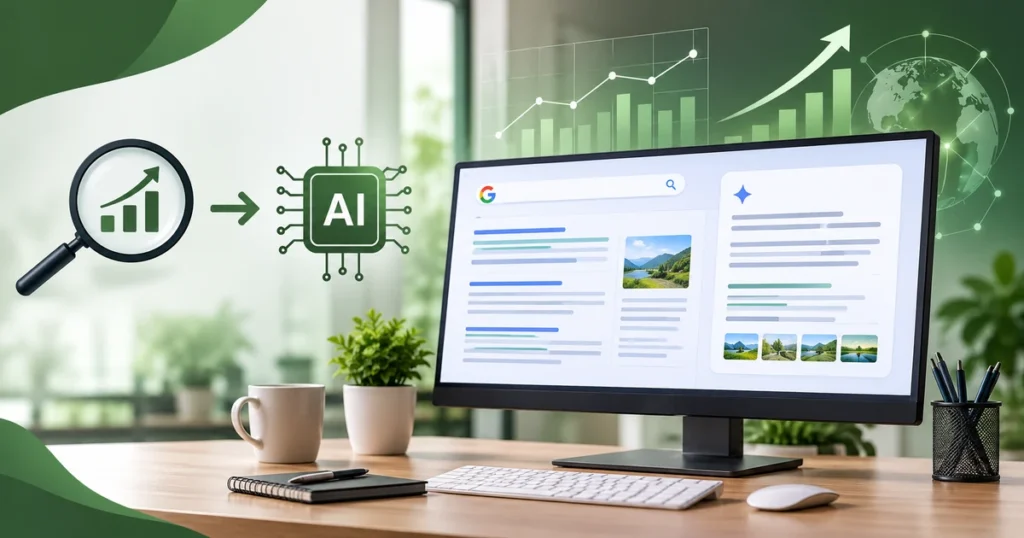
SEO is not dead in 2026. The way people discover information online is changing. Alongside traditional search results, people are increasingly seeing AI-generated summaries, conversational answers and source links in search experiences. For businesses, this creates a new challenge: being discoverable when customers search with keywords, ask complete questions or use AI tools to research their options.
The right response is not to abandon SEO or chase every new AI optimisation trend. It is to build a website that search engines and AI-powered experiences can understand, trust and confidently surface—while giving real visitors a useful reason to choose your business.
Why does it feel like SEO is changing?
Traditional search often presented a list of pages for a query. AI-powered search experiences can now summarise information, combine related subtopics and provide links that help users explore further. This changes the search journey: a person may get an initial answer on the results page, then visit a website to verify details, compare services or take action.
Google says its AI features, including AI Overviews and AI Mode, are built on its existing Search systems. Its guidance also confirms that pages need to meet the normal technical requirements for Search and be eligible to appear with a snippet; there is no separate special technical requirement for AI Overviews.
Is traditional SEO still important in 2026?
Yes. Crawling, indexing, useful content, clear site structure, relevant internal links, page experience and accurate information remain essential. If a search engine cannot access or understand a page, that page is unlikely to become a reliable source for an AI-powered answer either.
Think of SEO as the foundation, not an outdated tactic. AI search changes how information may be presented, but it does not remove the need for discoverable, relevant and trustworthy web pages.
What is different about AI search?
AI-powered experiences can interpret conversational questions and connect information from multiple sources. Instead of searching only for “digital marketing agency”, a potential customer might ask, “What should a small business check before hiring a digital marketing agency?” That question has a different intent and needs a more useful answer than a page repeating a service keyword.
- More conversational queries: people may describe a problem in their own words rather than use short keyword phrases.
- More context: AI experiences can respond to follow-up questions and compare related information.
- More emphasis on source quality: clear, accurate and useful pages give systems and readers something meaningful to evaluate.
- Different discovery journeys: some users may arrive after reading an AI summary, while others may still click a conventional search result.
AEO and GEO: do businesses need them?
Answer Engine Optimization (AEO) is commonly used to describe making content easy to understand and use when answering specific questions. Generative Engine Optimization (GEO) is commonly used for improving the clarity, usefulness and credibility of content in generative AI discovery experiences.
These terms can help teams discuss changing search behaviour, but they should not be treated as magic ranking systems or guaranteed shortcuts. Google’s current guidance stresses foundational SEO and valuable, original content rather than special AI-only tricks. Our earlier guide explains the differences between SEO, AEO and GEO in more detail.
How can a business improve its visibility in AI search?
1. Publish genuinely useful, original content
Answer the questions customers actually ask. Explain your process, pricing factors, service limitations, local experience and decision criteria where relevant. Add examples, first-hand insights and practical detail instead of rewriting the same generic advice found everywhere.
2. Make every important page easy to understand
Use descriptive page titles, one clear main heading, meaningful subheadings and concise paragraphs. Explain services in plain language. Keep important information in crawlable page text rather than hiding essential details only inside images, animations or inaccessible widgets.
3. Strengthen technical SEO
Check that important pages can be crawled and indexed, use sensible canonical URLs, fix broken internal links, maintain XML sitemaps and avoid accidental noindex settings. Improve mobile usability and page performance so visitors can access information without friction.
4. Use structured data accurately
Where appropriate, add relevant Schema.org structured data that reflects the visible content on the page—for example, Organization, LocalBusiness, Article or BreadcrumbList. Validate the markup and keep it consistent with the real business and page details. Structured data helps describe content; it does not guarantee an AI citation or a rich result.
5. Build clear brand and business signals
Keep your business name, services, contact details and location information consistent across your website and legitimate business profiles. Publish clear About, Contact and service pages. Show who is responsible for the content and provide evidence for claims, case studies and testimonials.
6. Measure outcomes, not just rankings
Continue monitoring Search Console impressions, clicks, queries and indexing. Review analytics for engaged visits, enquiries and conversions. Where available, monitor referral traffic from AI platforms separately. Do not judge success from a single AI answer or an isolated visibility screenshot.
Common AI SEO mistakes to avoid
- Publishing large volumes of generic AI-written pages without expert review or original value.
- Adding unnecessary schema, hidden text or invented claims in the hope of influencing AI answers.
- Creating a separate page for every tiny keyword variation instead of satisfying the real search intent.
- Assuming that an AI mention, citation or ranking can be guaranteed by an agency or tool.
- Ignoring technical SEO, website usability and conversion paths while focusing only on AI visibility.
What should businesses do next?
Start with a practical review of your website. Identify the pages that bring enquiries, check whether search engines can access them, improve outdated or thin content, add useful answers to genuine customer questions and make your services easy to understand. Then measure whether those improvements lead to better-quality visits and business enquiries.
AI search is another reason to invest in a strong digital presence—not a reason to throw away the SEO work that already matters. Businesses that combine technical foundations, original expertise, clear brand information and helpful user experiences will be better prepared as discovery continues to evolve.
Final thoughts
SEO is not dead; it is adapting. The goal is no longer simply to place keywords on a page. It is to make your business easy to find, understand and trust across the ways people search today. Build for people first, maintain strong SEO fundamentals and treat AEO and GEO as useful ways to think about content clarity—not as guaranteed ranking hacks.
Need help improving your website’s search visibility? Talk to Rayans Creative about a practical SEO strategy for your business.
Sources and further reading
- Google Search Central: Optimizing your website for generative AI features
- Google Search Central: AI features and your website
- Google Search Central: Creating helpful, reliable, people-first content
- Bing Webmaster Guidelines
Have a Project in Mind?
Bring your next business idea forward with the right mix of strategy, creativity and digital execution. Let’s discuss what your business needs.