Digital Marketing

Practical guides on digital marketing strategies, online visibility, customer acquisition, marketing channels and sustainable business growth.

digital marketing trends 2026-rayans creative
Digital Marketing

15 Latest Digital Marketing Trends in 2026 That Every Marketer Should Know

15 Latest Digital Marketing Trends in 2026 That Every Marketer Should Know The world of digital marketing is always changing. Strategies that worked a couple of years ago may not work as effectively now. With the fast growth in Artificial Intelligence (AI), changes in consumer behaviour, and increased popularity of social media, it is important for companies to keep up with the modern marketing trends. Digital marketing in 2026 is becoming smarter, personal, automated and customer orientated. With AI marketing, Generative Engine Optimisation (GEO), short form video and Social Commerce becoming more popular there are more ways than ever for marketers to connect with their target audience. If you are a business owner, digital marketer, SEO expert or content creator, you will benefit from knowing what changes are happening. Let’s take a look at the 15 latest digital marketing trends in 2026 to be aware of as a marketer. 1. AI-Powered Digital Marketing Artificial Intelligence has become an important part of modern digital marketing. Businesses and marketing professionals are using AI tools to improve productivity, understand customer behaviour, and create marketing campaigns more efficiently. AI can help marketers with:  Generating blog topics and content ideas.  Creating social media captions and advertisements.  Analysing customer behaviour.  Automating repetitive marketing tasks.  Creating marketing reports.  Improving audience targeting. Popular AI tools such as ChatGPT, Gemini, Claude, and Canva AI are helping marketers simplify their daily activities.However, AI should support human creativity and strategic thinking rather than completely replace them. 2. Answer Engine Optimization (AEO) and Generative Engine Optimization (GEO) Traditional SEO aims to increase visibility in search engines. However, with new AI-based systems like ChatGPT, Google AI Overviews and Perplexity. People are using more AI tools to get direct answers. As a result there has been an increasing interest in optimising for: Answer Engines (AEO) – providing clear answers. Generative Engines (GEO) – increasing your brand visibility and likelihood of being mentioned. To improve your visibility in AI search you should: Create useful and unique content. Answer specific questions. Showcase your expertise and authority. Use clear headings and appropriate schema. Build your brand authority with relevant mentions and digital PR. Ensure your key business information is accurate. The future of search marketing requires knowledge of traditional search engines and AI based discovery platforms. for more: Beyond SEO: How to Optimise Your Website for People, Search & AI 3. Short-Form Video Marketing Short-form videos continue to play an important role in digital marketing. Platforms such as Instagram Reels, YouTube Shorts, and Facebook Reels allow brands to reach audiences through engaging and easily consumable content. Businesses use short videos to introduce products, explain services, share customer experiences, and increase brand awareness. Popular short-form video ideas include:  Product demonstrations.  Behind-the-scenes videos.  Educational tips and tutorials.  Before-and-after videos.  Customer testimonials.  Trending challenges. For small businesses, short-form videos provide an opportunity to showcase products and services without requiring expensive advertising campaigns. For more about this: The Rise of Short-Form Video: How Businesses Can Use Reels & Shorts Effectively 4. Influencer and Micro-Influencer Marketing Influencer marketing is becoming an important strategy for brands looking to connect with specific audiences. Instead of collaborating only with celebrities and large influencers, businesses are increasingly exploring partnerships with micro-influencers who have smaller but more focused communities. Micro-influencers can help businesses reach niche audiences through product reviews, tutorials, recommendations, and authentic experiences. For example, a beauty salon can collaborate with a local beauty creator to showcase its services and attract potential customers. The right influencer partnership should focus on audience relevance, engagement, credibility, and campaign objectives rather than follower count alone. 5. Social SEO: Social Media as a Search Engine Social media is an important way to find new businesses, products, services and recommendations. Instagram, YouTube, and Pinterest all help with discovery. You may search for: Best Digital Marketing Agency Kannur Best Skincare Products for Oily Skin Cheap Wedding Photographer Best Restaurants Near Me By including relevant keywords in your profile description, captions, video titles and on-screen text you can boost your social media discoverability. Social SEO can boost your brands visibility when potential customers search for your brand directly on the social media platform. 6. Conversational Marketing and WhatsApp Business Customers are favouring instant and easy communication. Using conversational marketing, businesses can engage with potential customers using messaging platforms, chatbots and automation. WhatsApp Business has been very useful for businesses within India. Common uses for WhatsApp Business include: Automated responses Product Catalogue Booking Appointments Customer Support Lead Generation Follow Ups A digital marketing agency could create a Click to WhatsApp advert to encourage people to get in direct contact with their business. This helps to reduce any barriers between the two parties and makes it an easy process for customers. 7. Hyper-Personalization in Marketing Modern customers expect relevant experiences rather than generic promotional messages. Hyper-personalization uses customer preferences, behaviour, and available data to deliver more relevant marketing communication. Examples include personalized email campaigns, product recommendations, location-based offers, and customized advertisements. For example, an online clothing store can recommend products based on a customer’s previous browsing or purchase behaviour. Personalization helps businesses improve customer engagement and create stronger relationships with their audiences. 8. User-Generated Content (UGC) User-Generated Content refers to content created by customers rather than directly by brands. It includes customer reviews, testimonials, product photographs, unboxing videos, and personal experiences. UGC is valuable because potential customers often look for real experiences before making purchasing decisions. Businesses can encourage customers to share their experiences and feature suitable content on their websites and social media platforms, with appropriate permission. This helps build social proof, trust, and brand credibility. 9. AI-Generated Videos and Creative Content AI is transforming how marketers create visual content. Earlier, producing professional advertisements and promotional videos often required considerable time, resources, and technical skills. Today, AI-powered tools are making creative production more accessible. Popular applications include: AI-generated product advertisements.  Animated promotional videos.  AI voiceovers.  Virtual presenters and avatars.  Automated video editing.  Creative variations for advertising campaigns. Tools such as Runway, Kling AI,
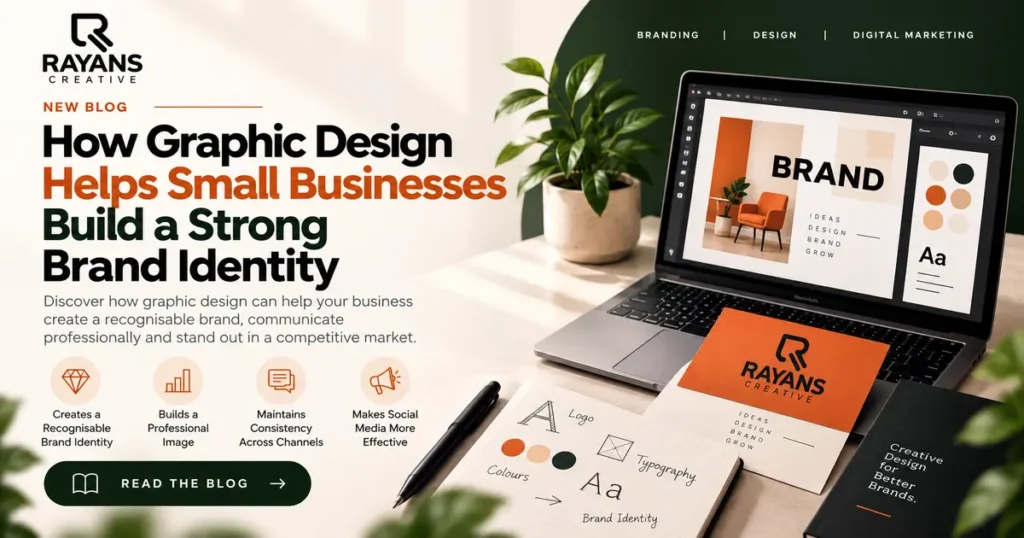
Rayans creative graphic design poster showing how graphic design helps small businesses build a strong brand identity.
Digital Marketing

How Graphic Design Helps Small Businesses Build a Strong Brand Identity

How Graphic Design Helps Small Businesses Build a Strong Brand Identity In today’s competitive market, it can be difficult to stand out and shine with just a great product or service. With customers taking note of how your business looks, from your logo and website, social media posts and packaging it all adds up to help shape how people see your brand.This is where Graphic Design comes in!Small business Graphic Design is used to help convey your brand message. This can be done through the use of colour schemes, fonts, layout and imagery. When everything works together it helps build a recognisable brand and allows your business to look more professional.If you have a small retail shop, start-up, restaurant or service based company investing in considered Graphic Design will help create a strong brand identity.In this article we will look at how Graphic Design can help your business branding! What Is Graphic Design in Branding? Graphic design in branding is the process of using visual elements to communicate a business’s identity, values andpersonality.It includes several elements, such as:  Logo design: A visual mark that identifies your business. Colour palette: A set of colours used consistently across brand materials.  Typography: Fonts and text styles that establish a visual character.  Marketing materials: Posters, brochures, advertisements and promotional creatives. Social media graphics: Visual content that maintains a consistent brand appearance online.  Packaging and stationery: Physical brand materials that customers interact with. Together, these elements contribute to a brand identity that customers can recognise across different platforms. 7 Ways Graphic Design Helps Small Businesses Build a Strong Brand Identity 1. Creates a Recognisable Brand Identity Brand recognition develops when customers repeatedly encounter consistent visual elements associated with a business.A distinctive logo, consistent colours and recognisable typography can help customers identify your business across your website, social media profiles, advertisements and printed materials.For example, a jewellery business might use an elegant typography style, a carefully selected colour palette and consistent product photography across its marketing channels.Over time, using these elements consistently can help create a recognisable visual identity.Why it matters: Small businesses need to establish a clear identity that customers can associate with their productsand services. 2. Builds a Professional Business Image First impressions can influence how potential customers perceive a business.A website with inconsistent fonts, poorly aligned layouts or low-quality graphics may appear less professional. In contrast, well-organised visual content can make information easier to understand and give the business a more consistent appearance.Professional graphic design helps businesses present their services clearly through: Well-structured promotional posters. Readable typography and balanced layouts.  High-quality product images.  Consistent business presentations.  Professional brochures and marketing materials. Good design does not guarantee customer trust, but it can support a more credible and professional presentation. 3. Maintains Consistency Across Marketing Channels Customers may discover your business through Google, Instagram, Facebook, your website or printed advertisements. If every platform uses different colours, fonts and visual styles, customers may find it harder to connect those communications with the same brand. A consistent visual identity helps create a unified experience.For example, a restaurant can use the same brand colours and typography across its menu, social media posts,promotional offers, website and takeaway packaging.A simple brand guideline document can help maintain consistency as the business grows. 4. Makes Social Media Content More Effective Social media is an important communication channel for many small businesses. However, publishing content regularly is only one part of an effective strategy. The content also needs to communicate the message clearly.Graphic design helps businesses create: Promotional posts and offer announcements. Product showcases. Educational carousels. Event announcements. Infographics and informative graphics.  Consistent templates for recurring content. A well-designed social media post uses visual hierarchy to guide attention towards the most important information.For instance, a promotional poster should make the offer, product and call to action easy to identify without overcrowding the design.Remember that effective social media performance also depends on the quality of the offer,audience relevance,content strategy and distribution. 5. Helps Businesses Stand Out From Competitors In crowded markets, businesses often offer similar products or services. A clear visual identity can helpcommunicate what makes one business different.Consider two clothing boutiques selling similar products. One uses inconsistent promotional designs, while the othermaintains a distinctive visual style across its product photography, packaging and social media content.The second boutique may create a more coherent brand experience.Graphic design can support differentiation through:  A distinctive visual direction. Consistent product presentation. Brand-specific colours and typography. Creative campaign concepts.  Packaging that reflects the brand’s positioning. The objective is not simply to look different. It is to communicate the right personality and value to the intended audience. 6. Improves Marketing Communication Customers should be able to understand the purpose of a marketing message quickly.Poorly organised graphics can make important information difficult to find. Too many fonts, excessive text, low contrast and unnecessary decorative elements can distract from the main message.Graphic design uses visual hierarchy, spacing, contrast and alignment to organise information.For example, an educational institution advertising a new course should clearly present the course name, key benefits, admission information and contact details.When information is organised logically, customers can understand the message more easily and identify the next step. 7. Supports Business Growth Across Different Touchpoints As a small business expands, its visual communication needs may increase. It might introduce new products, launch a website, advertise on social media or open another location.A well-defined brand identity provides a foundation for these activities.Businesses can extend their visual identity across: Websites and landing pages.  Digital advertising campaigns. Business presentations. Product packaging. Printed promotional materials. Event branding. Email marketing graphics. This creates a more consistent brand experience as the business develops.Although graphic design can support marketing and communication, actual business growth also depends on factors such as product quality, customer service, pricing, demand and sales strategy. Essential Graphic Design Elements Every Small Business Needs Here are some useful design essentials.1. A professional logoYour logo should be suitable for different sizes and applications, including websites, social media profiles, packagingand printed materials.2. A consistent colour

amul branding strategy and lessons in brand marketing
Digital Marketing, Uncategorized

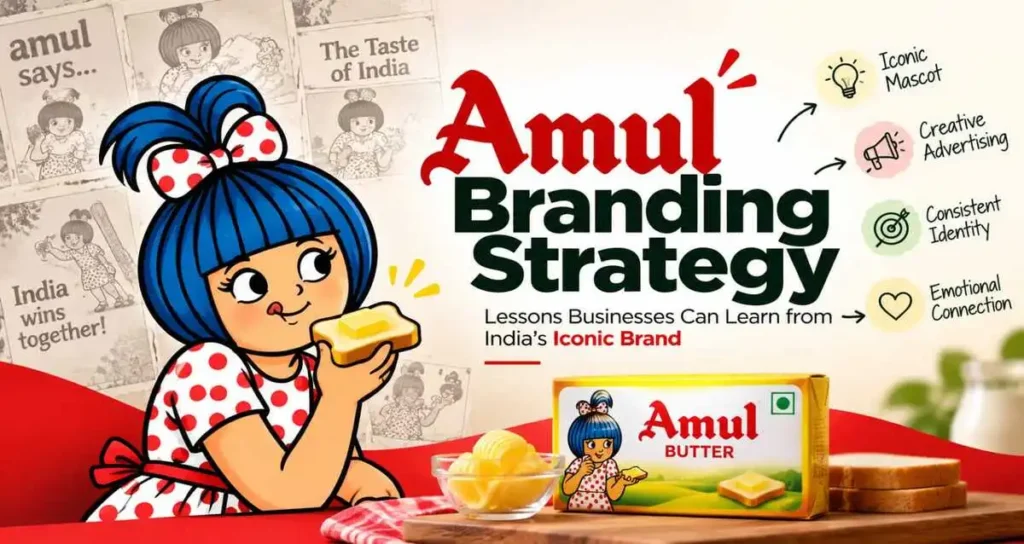
Amul Branding Strategy: Lessons Businesses Can Learn from India’s Iconic Brand

Amul Branding Strategy: Lessons Businesses Can Learn from India’s Iconic Brand There are brands that sell products and there are brands that integrate themselves into people’s daily lives. The former applies to brands like Amul, which have made a mark with their distinct butter packs and humorous advertisements with the famous Amul girl. The achievements of the Amul brand go beyond just the dairy products category. It has much to do with branding, storytelling, culture, and trust of customers in the long run. In the highly competitive environment where firms compete for customers’ attention all the time, Amul shows how important it is to have a good brand identity and marketing strategy to be successful. Let us analyze the Amul brand strategy and useful insights that other businesses can derive from it. What Is Amul’s Branding Strategy? Amul’s branding strategy is based on building a recognisable identity through consistent visual elements, relatable advertising, memorable messaging and strong connection with Indian consumers. Familiar packaging, accessible communication, humour and topical advertising keep the brand relevant to its audience. Instead of merely pushing its products, Amul often links its messaging to current events, popular culture and day-to-day life. This strategy helps Amul to connect with different generations of consumers and at the same time, retain the brand recognition. What Makes Amul’s Branding Strategy So Successful? Amul’s branding success comes from several elements working together. Its consistent identity makes the brand easy to recognise, while its creative advertising keeps audiences interested. The Power of the Amul Girl One of the most recognisable elements of Amul’s branding is the Amul Girl, the cartoon mascot associated with its famous butter advertisements.Introduced in 1966, the Amul Girl became a distinctive part of the brand’s identity. Her playful appearance, blue hair, red polka-dot dress, and witty comments make the advertisements memorable. The character also gives Amul a recognisable voice. Instead of using conventional product advertisements every time, the brand often uses humour and topical references to communicate with its audience. Branding lesson: A memorable mascot, character, or visual element can help a business build a distinctive identity. Small businesses can develop a consistent brand personality that customers recognise across websites, advertisements, and social media platforms. Consistent Brand Identity Amul maintains a familiar visual identity across its products and advertising. Its well-known logo, packaging, colours, and typography help customers recognise the brand quickly. Consistency is important because customers encounter brands through multiple touchpoints, including product packaging, retail displays, advertisements, and digital platforms. When a business uses the same visual elements and tone of voice consistently, it becomes easier for customers to remember and identify that business. Branding lesson: Businesses should establish clear brand guidelines covering their logo, colours, fonts, imagery, and communication style. Consistency across marketing channels helps create a professional and recognisable brand. Topical Advertising and Real-Time Marketing Amul is widely known for its topical advertisements, which creatively respond to current events, sports, entertainment, and social conversations. These advertisements often combine humour, wordplay, and the familiar Amul Girl character to connect the brand with topics people are already discussing. This approach demonstrates how advertising can become more than a product promotion. It can also create conversations and encourage people to engage with a brand. However, successful topical marketing requires good timing, creativity, and sensitivity to the subject being discussed. Branding lesson: Businesses can use relevant trends, festivals, industry news, and audience interests to create timely content. The key is to choose topics that fit the brand instead of following every trend. Emotional Branding and Cultural Connection Amul has built a strong connection with Indian consumers by making its brand part of everyday food habits, family experiences, and familiar cultural moments. Its advertisements often use relatable situations and humour rather than focusing exclusively on product features. This makes the communication accessible to a broad audience. Emotional branding helps customers associate a product with experiences, memories, and feelings. Over time, these associations can contribute to trust and brand loyalty. Branding lesson: Businesses should understand what matters to their target audience. Content that reflects customers’ needs, values, and everyday experiences can create a stronger connection than advertisements focused only on selling. Simple and Memorable Messaging Amul’s topical advertisements are known for short, witty lines that connect a current event with the brand. Simple messaging is powerful because people often encounter advertising while scrolling through social media, browsing websites, or moving through their daily routines. A message that is easy to understand and remember has a better chance of making an impression.   Branding lesson: Businesses should communicate their value clearly. Instead of using complicated marketing language, focus on a simple message that explains what the business offers and why it matters to customers. Staying Relevant While Maintaining Brand Identity Marketing trends and consumer preferences change constantly. Amul demonstrates how a brand can respond to changing conversations while retaining familiar elements of its identity. The Amul Girl, the brand’s established visual style, and its distinctive use of humour provide continuity, even when individual advertisements address different topics. This balance between consistency and adaptation is important for long-term branding. Branding lesson: Businesses should update their content and marketing methods as audiences change, while maintaining the core elements that make their brand recognisable.   Key Elements of Amul’s Branding Strategy at a Glance Branding elements How amul uses it Lesson for businesses Brand identity Familiar logo,packaging and mascot Maintain consistent visual branding story telling Humorous and relatable advertisement. Make content interesting and memorable. Real time marketing Topical advertisement Respond to relevant trends and events Emotional connection Familier cultural and everyday references Understand your audiences Brand personality Witty and distinctive communication Develop a consistent tone of voice Long tern consistency Repeated use of recognisable brand elements Build recognition overtime How Small Businesses Can Apply Amul’s Branding Strategy Amul’s branding strategies are applicable not only among giants but also small companies, start-ups, and local brands managed to create remarkable images within their limited budgets. There are six essential strategies that might be implemented by an