
AI in Digital Marketing:Tools,Types and Trends
Artificial Intelligence (AI) is playing a significant role in changing the way organizations work and connect with their customers and promote their offerings and services. AI is playing an important role in helping marketers create social media content, analyse customer behaviour, manage marketing data and devise smart marketing plans.
Today all types of organizations are using AI tools for improving productivity, gaining insights into consumers, and remaining relevant in the digital world.
However, what exactly is AI, and what are its main forms? How organizations can benefit from AI tools in digital marketing?
In this post, we will investigate what artificial intelligence is, what types of AI exist, and what the best AI tools for digital marketing are.
1. What Is Artificial Intelligence (AI)?
Artificial Intelligence, commonly known as AI, is a branch of computer science that enables machines and software to perform tasks that typically require human intelligence.
These tasks include understanding language, recognising images, identifying patterns, generating content, making predictions, and solving problems.
For example, when you ask ChatGPT to write a blog outline, use Google Maps to find a route, or receive personalised product recommendations while shopping online, you are interacting with AI-powered technology.
AI can process large amounts of data, identify useful patterns, and assist people in making informed decisions.
In digital marketing, AI helps businesses research keywords, create content, analyse campaign performance, automate repetitive tasks, and personalise customer experiences.
Example: A digital marketing agency can use AI to generate social media content ideas, analyse website traffic, and identify potential improvements to an SEO strategy. A marketer still needs to review the output and make decisions based on business goals.
2. What Are the Main Types of AI?
Artificial intelligence can be categorized in various ways. A common categorization is made according to capabilities.
2.1 Narrow AI (Artificial Narrow Intelligence)
Narrow AI has the capability to carry out a particular task or a series of tasks closely related to each other. Thus, most of today’s AI applications are of narrow AI type.
Some examples would be:
- Chatbots providing answers to customers.
- Recommendation systems suggesting consumer products.
- AI assistants that help with writing the texts.
- Image recognition systems that are responsible for object identification.
- AI-driven tools that assist with marketing analysis.
Digital marketing example: An AI tool generating text for ads or discovering keywords performs the necessary job instead of possessing a human-like intelligence.
2.2 General AI (Artificial General Intelligence)
General AI means hypothetical AI capable of learning, understanding, and performing a range of intellectual processes comparable to humans.
This technology is a goal of research and development, and it is not available at present.
Digital marketing example: Hypothetical general AI technology can independently analyze a company, develop a marketing strategy, and make several decisions in various areas of business.
2.3 Super AI (Artificial Superintelligence)
The definition of Artificial Superintelligence refers to the type of AI that might exceed human intelligence level in all the information–related tasks. Thus, it can be concluded that it does not currently exist as a marketable product in present. Thus, it can be said that the distinction of the above categories is necessary for understanding the available AI types used today as compared to future developments.
3. What Is AI in Digital Marketing?
Using artificial intelligence technology is referred to as “AI in Digital Marketing” to create strategies and enhance marketing campaigns. Typically, for traditional marketing, marketers look for information manually as they create content, analyze data and monitor campaigns. AI provides assistance with the process of information gathering and processing in order to get insights from the data available.
Here are some examples of AI applications:
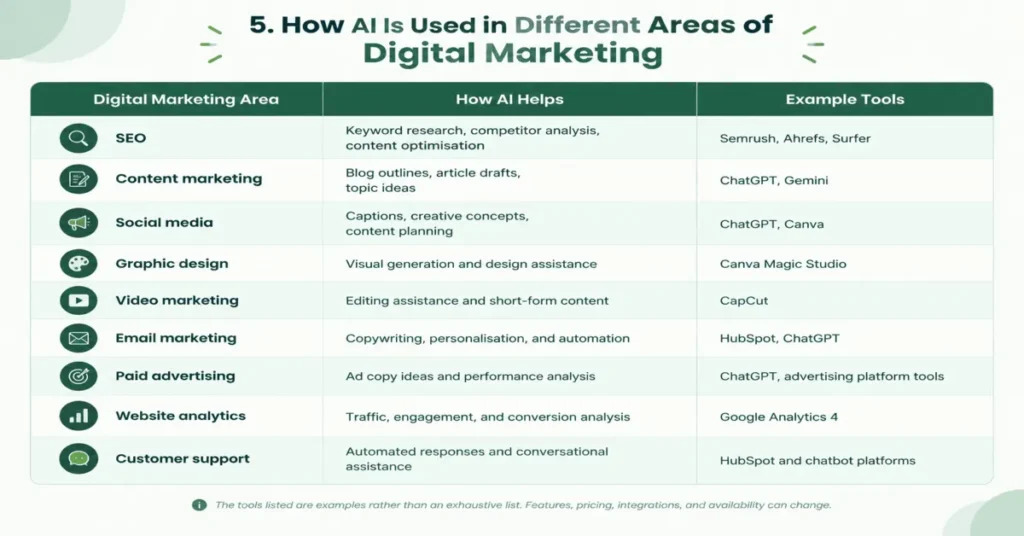
Search Engine Optimisation (SEO): conducting keyword research and creating content briefs, clustering topics and analyzing technical problems.
Content marketing: creating outlines for blog entry and drafts for articles, repurposing content and conducting gap analysis.
Social media: coming up with ideas for posts and captions, planning the content and coming up with creative ideas.
Paid advertising: creating different versions of ads and getting insight about audiences.
Email marketing: personalizing content and brainstorming subject lines.
Customer service: using chatbots, answering frequently asked questions and replying automatically.
Analytics: searching for patterns and presenting reports on the effectiveness of campaigns.
AI is most effective when it serves to implement a clear marketing strategy and complements human creativity, experience and decision-making.
4. Best AI Tools for Digital Marketing
There are a range of platforms reliant on AI technology that can help marketers to enhance productivity. But your choice should take into account your marketing goals, budget, available tools, and business processes.
4.1 ChatGPT – Ideal for Content and Marketing Ideas
ChatGPT provides marketers with the opportunity to generate ideas, create a blueprint for the blog posts, formulate marketing copy and design effective marketing campaigns.
Best for:
- Creating blueprints for blog posts.
- Generating ideas for social media posts.
- Generating variations of marketing texts.
- Formulating a marketing strategy and conducting brainstorming.
- Responding to various queries or creating documents.
Case: A digital agency can hire ChatGPT to make a monthly content plan for a beauty salon and adjust each post according to the brand identity.
4.2 Google Gemini
Google Gemini can support the process of conducting research, writing, brainstorming, summarising, etc. The availability of its functions is determined by the version of the product and connected Google services.
Best for:
- Generating ideas for content.
- Summarising the needed information.
- Brainstorming ideas for advertising campaigns.
- Drafting various marketing materials.
- Supporting the process of conducting research.
4.3 Semrush — SEO Research Tool
Semrush is an SEO and digital marketing tool that has SEO, keyword research, competitor analysis, site audit, and content tools. Some tools utilize AI.
Suitable for:
- Keyword research.
- Competitor analysis.
- SEO audit.
- Search visibility tracking.
- Content opportunities identification.
For instance, an SEO expert can leverage Semrush to find the right keywords and analyze competing web pages when developing an SEO content strategy.
4.4 Ahrefs — SEO and Backlink Analysis Tool
Ahrefs is a software that offers keyword research, backlinks analysis, competitor research, and site investigation tools.
Suitable for:
- Backlink profile analysis.
- Competitor keyword research.
- Finding link-building opportunities.
- Identifying content gaps.
- Organic search performance investigation.
Ahrefs is mainly an SEO platform, not an AI tool per se, yet it could be used to facilitate an AI-driven marketing process.
4.5 Canva Magic Studio — Visual Content Creation Tool
AI capabilities in Canva help users develop marketing visual content such as images and graphics.
Suitable for:
- Social media banners.
- Presentation designs.
- Marketing graphics.
- Image editing and design.
- Brand content creation.
For example, a small business can create an Instagram promotion banner with the use of AI in Canva based on the template and make it match the branding of the company.
4.6 Grammarly – For Writing Improvement
It offers writing assistance for grammar, clarity, tone, and many other communication areas. Some additional AI-based writing tools depend on the chosen subscription package.
Good for:
- Blog post proofreading.
- Sentence clarity improvement.
- Professional communication checking.
- Marketing copy checking.
Ensuring the same writing tone.
4.7 Surfer – For SEO Content Optimization
The tool can help marketers analyse the search results and improve content structure and relevance due to some AI content optimisation tools.
Good for:
- Content optimization.
Topic and terms analysis.
- Planning content.
- On-page content review.
- SEO content brief creation.
Do not use these recommendations as a guarantee of ranking. Content should be of high quality and meet search intent.
4.8 HubSpot – For Marketing Automation
It offers various marketing tools and many others such as CRM and customer service tools. Also, it can offer some AI-powered tools in supported products and packages.
Good for:
- Customer relationship management.
- Leads management.
- Email marketing workflow.
- Campaign management.
- Marketing automation and reporting.
4.9 CapCut – For Video Content
It offers some AI-assisted video editing and content production tools, but feature availability can vary in different versions of the software and regions.
Good for:
- Short form videos.
- Instagram Reels.
- Captions.
- Video editing assistance.
- Reposting social media content.
4.10 Google Analytics 4 – For Website Insights
This tool can help businesses analyse website and application interactions and make data-driven marketing decisions thanks to its analytics and insights features.
Good for:
- Website traffic measurement.
- User engagement analysis.
- Conversions measurement.
- Comparing traffic sources.
- Campaigns performance evaluation.
Google Analytics 4 is an analytics platform rather than a generative AI writing tool.
5. How AI Is Used in Different Areas of Digital Marketing
6. Benefits of Using AI in Digital Marketing
6. Advantages of Applying AI in Digital Marketing
Saves Time
Artificial intelligence may accelerate routine tasks like writing first draft, sorting out information and creating reports. That will allow marketers to devote their efforts to strategy planning.
Facilitates Data-Driven Decisions
AI-assisted analysis could assist in uncovering patterns of customers’ behavior and preferences and campaign results.
Increases Content Effectiveness
Marketers are able to create outlines and explore various options using artificial intelligence, as well as adjust content to various channels.
Promotes Personalization
If necessary, artificial intelligence is able to assist in creating customized recommendations, messaging and content for customers.
Assists Smaller Companies
Artificial intelligence tools could be an affordable option for smaller companies, enabling them to do more without spending too much time.
Encourages Experimentation
Using artificial intelligence, marketers could try different versions of headlines, captions and advertisement copy, finding what works best for their customers.
Still, none of these advantages is guaranteed. It will depend on the quality of execution, availability of data and review process of AI output.
Frequently Asked Questions About AI
- What is AI in simple words?
Artificial Intelligence is technology that enables computers to perform tasks such as recognising patterns, understanding language, generating content, and making predictions.
- What are the three main types of AI?
A common capability-based classification includes Narrow AI, Artificial General Intelligence (AGI), and Artificial Superintelligence (ASI). Narrow AI is widely used today, while AGI and ASI remain hypothetical or theoretical concepts.
- Which AI tools are useful for digital marketing?
Useful tools include ChatGPT, Google Gemini, Canva Magic Studio, Semrush, Ahrefs, Grammarly, Surfer, HubSpot, CapCut, and Google Analytics 4. Each serves different purposes, and not all are dedicated generative AI tools.
- Can AI replace digital marketers?
AI can automate or assist with certain tasks, but digital marketers remain important for strategy, creativity, customer understanding, brand positioning, ethical decisions, and performance evaluation.
- Is AI-generated content good for SEO?
AI-assisted content can support SEO when it is accurate, original, helpful, and aligned with search intent. Content should be reviewed and improved by people rather than published at scale without quality control.
- Are AI tools suitable for small businesses?
Yes. Small businesses can use AI tools for content ideas, social media planning, writing assistance, design, customer communication, and marketing analysis. They should select tools according to their goals, budget, and privacy requirements.
Conclusion
Artificial Intelligence is changing digital marketing by helping businesses research faster, create content more efficiently, analyse data, and improve customer experiences.
From ChatGPT and Gemini to Canva, Semrush, Ahrefs, and Google Analytics 4, different tools can support different stages of a marketing campaign. The key is to select the right tools for your objectives and use them responsibly.
At Rayans Creative, we believe effective digital marketing combines the power of modern technology with creativity, strategy, and a strong understanding of customers. AI can help businesses work smarter, but meaningful growth still depends on delivering real value to the people they serve.