
Google September 2026 spam update: What it means for your website.
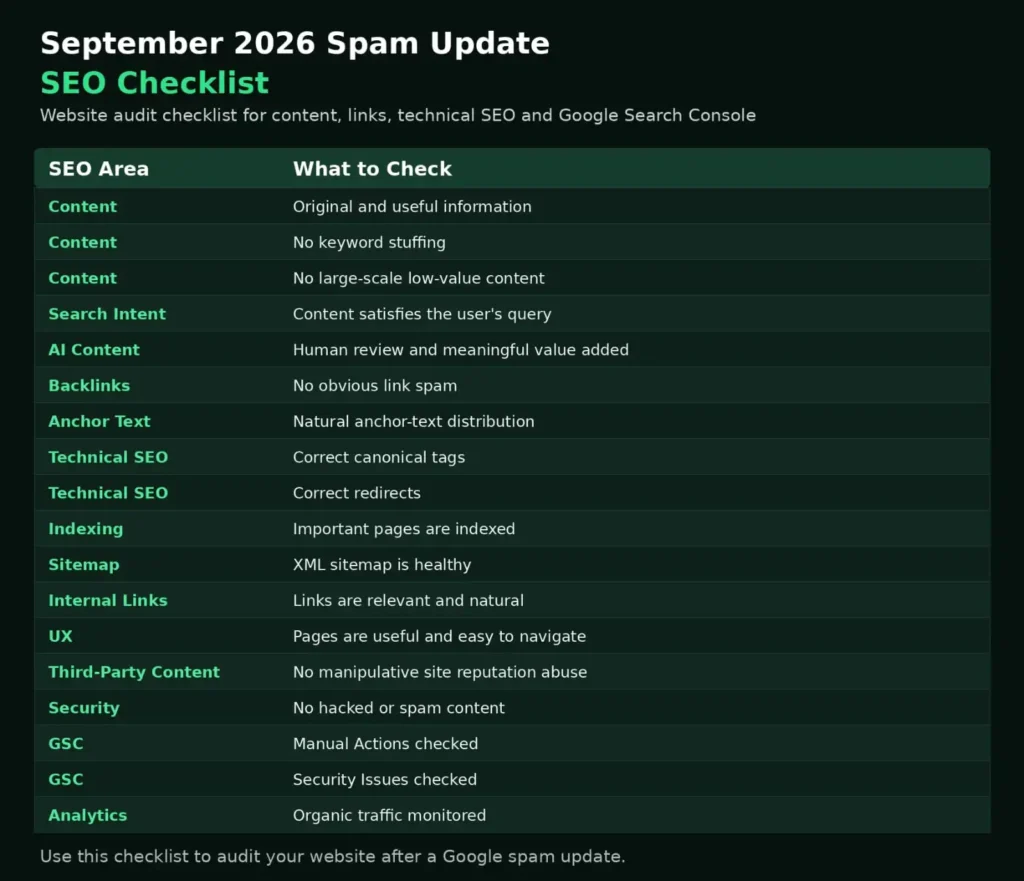
Spam Update September 2026 has finally been announced by Google as the new update to the detection and handling system for search spam.
The update was started on September 24, 2026, at 9:15 a.m. PDT and is applicable on global level to all languages. Google indicates that the deployment process will take up to two weeks to finish. As of October 5, 2026, the Search Status Dashboard of Google shows the update is still in action.
For webmasters, SEO specialists and digital marketers, the update is a good example that shows SEO has to be more than keywords and backlinks. Websites should concentrate on providing helpful content and using proper SEO techniques.
1. What is the Google September 2026 Spam Update?
The Google September 2026 Spam Update is a Google Search update that aims to enhance Google’s spam detection and processing systems.
According to Google, its automatic spam detection systems work at all times, but sometimes Google makes considerable improvements to those systems and refers to such changes as spam updates. The system used by Google to combat spam is SpamBrain, an AI-based system developed by Google.
Webpages violating the spam policies set by Google are likely to be ranked low or will not even be included in Google search results.
That is why the webmaster of the page should not concentrate solely on the ranking after the update.
- When Did the September 2026 Spam Update Start?
Google officially released the September 2026 Spam Update on September 24, 2026, at 9:15 a.m. PDT.
| Update details | Information |
|---|---|
| Update | September 2026 spam update |
| start date | September 24,2026 |
| Start time | 9:15 a.m PDT |
| Coverage | Global |
| Language | All languages |
| Type | spam update |
| Affected area | Google search ranking |
| Expected rollout | upto 2 weeks |
| status on oct 5 | Active |
3. Is the September 2026 Spam Update still being implemented?
Yes.
At least until October 5, 2026, Google’s Search Status Dashboard has not ceased labeling the September 2026 Spam Update as Active.
Google said the implementation would be completed in two weeks.
Hence, if you observe any shifts in rankings or traffic in this time period, then do not rush to make conclusions about their permanency.
It is preferable to:
Observe → Analyze → Audit → Address true problems → Reassess
than making big decisions based on a short-term observation period.
4.Is It a Google Core Update?
No.
The September 2026 update is spam-related, rather than a core update.
This is because Google classifies spam updates separately from core updates within its history of ranking updates.
The reason why this is significant is that the process of investigation will differ.
| spam update | core update |
|---|---|
| Focuses on spam detection | Broadly reassesses search quality and relevance |
| related to spam policies | related to google’s broader ranking system |
| requires a spam policy review | Requires a broader content and quality review |
| May affect sites using manipulative practices | can affect many types of websites |
| Focus on compliance and quality | focus on overall usefullness and relevance |
If your website lost rankings during this update, start by checking Google’s spam policies.
5. What Is Google Targeting?
Google has not yet identified a single SEO technique that will be targeted by the Google Spam Update in September 2026.
Consequently, SEO experts should refrain from making false claims like:
“The September update targets all AI content.”
and,
“The September update targets backlinks only.”
However, webmasters can refer to Google’s spam policies that already exist.
These include:
- Scaled content manipulation
- Keyword stuffing
- Link spam
- Hidden text and links
- Scraping
- Misleading functionality
- Sneaky redirects
- Hacked content
- Site reputation manipulation
- User-generated spam
6. SEO Practices You Should Review
Keyword Stuffing
Keywords play a key role in SEO; however, too much emphasis on them can be considered harmful.
According to Google, keyword stuffing is described as placing keywords or numbers on pages to artificially improve ranking. Such instances may include unnecessary repetition of words and/or creation of lists of keywords and/or geographic locations without any real value.
Instead of repeating the following throughout the page:
“best digital marketing agency in Kannur”
consider using variations like:
Digital marketing agency in Kannur
Digital marketing services in Kannur
SEO agency in Kannur
Digital marketing company
Online marketing services
And so on…
Scaled Content Abuse
One of the most crucial sections to consider is scaled content abuse.
Scaled content abuse, according to Google, refers to the creation of numerous pages for the sole purpose of manipulating search engine ranking than assisting users.
This may involve producing vast quantities of pages through artificial intelligence or automated means, plagiarizing content, remixing content from various web sites without adding any value, and even producing keyword-based pages with no added value.
What is essential here is that the problem does not lie in the quantity of pages.
The critical question is:
Is the content produced for the benefit of users or for the sole purpose of manipulating search engines?
Link Spam
Backlinks can help websites build authority, but links created primarily to manipulate search rankings can violate Google’s spam policies.
Google’s examples of link spam include:
- Buying or selling links for ranking purposes
- Excessive link exchanges
- Automated link-building programs
- Links created through manipulative arrangements
- Paid articles containing links that pass ranking credit
- Optimized anchor text used in manipulative guest posts or press releases
A strong backlink strategy should focus on relevance, quality and genuine value rather than simply increasing the number of backlinks.
Scraped or Unoriginal Content
Copying content from other websites and publishing it without adding meaningful value can create a poor user experience.
If you use information from other sources, improve it with:
- Original analysis
- Examples
- Data
- Expert opinions
- Case studies
- Practical recommendations
Your article should offer something useful that readers cannot get simply by visiting the original source.
Site Reputation Abuse
Site reputation abuse is another area website owners should understand.
Google describes it as publishing third-party content on a website primarily to exploit the host site’s existing ranking signals.
Not all third-party content is automatically a violation. Google specifically distinguishes legitimate third-party content from content published without meaningful oversight or involvement primarily to manipulate search rankings.
Website owners should therefore be careful about allowing unrelated, low-quality third-party pages to accumulate on their domains.
- Does the Update Target AI-Generated Content?
It is one of the major concerns within the SEO community.And the answer is:Google hasn’t confirmed that the September 2026 Spam Update is focused on AI-generated content.
According to Google’s official guidelines, generative AI can be helpful for researching the topic and organizing the original content.
However, the mass generation of pages by AI without delivering any value to users could violate Google’s guidelines concerning the abuse of scaled content.
And the key point is:
AI-assisted content ≠ automatically spam
and
Large-scale low-quality content for manipulative purposes = potential spam problem
If you want to generate content by AI, remember that it should meet the following criteria:
- Accuracy
- Usefulness
- Originality
- Fact-checking
- Audience-relevancy
- Human editing
- Appropriate citation
- Mainly user-oriented
8. How to Check Whether Your Website Was Affected
If your organic traffic or rankings dropped after September 24, don’t immediately assume that the spam update caused the decline.
Use a structured process.
Step 1: Check Google Search Console
Go to:
Google Search Console → Performance → Search Results
Compare your data before and after September 24.
Look at:
Clicks
Impressions
Average position
CTR
Also compare with the same period from the previous year where useful.
Step 2: Check Your Important Keywords
Review your main commercial keywords.
For example, a digital marketing agency targeting Kannur may monitor:
Best digital marketing agency in Kannur
Digital marketing agency in Kannur
Digital marketing company in Kannur
Digital marketer in Kannur
Digital marketing services in Kannur etc..
Step 3: Check Your Landing Pages
Identify pages that experienced significant changes in:
-Organic clicks
-Impressions
-Average position
-CTR
Then audit those pages individually.
Step 4: Check Manual Actions
Open:
Google Search Console → Security & Manual Actions → Manual Actions
If Google has issued a manual action, Search Console will provide information about the problem.
Also check the Security Issues section for possible website security problems.
Google recommends using Search Console’s Manual Actions and Security Issues reports when investigating potential spam or security problems
9. What to Do If Your Rankings Dropped
Don’t immediately delete pages or build hundreds of backlinks.
Instead, perform a complete SEO audit.
Content Audit
Ask:
Does the page satisfy search intent?
Is the information accurate?
Does it provide original value?
Is the content unnecessarily repetitive?
Does it contain useful examples?
Is it written primarily for people?
Technical SEO Audit
Check:
Indexing
Canonical tags
Redirects
404 errors
Robots.txt
XML sitemap
Internal links
Mobile usability
Website performance
Backlink Audit
Review your backlink profile for:
Spammy domains
Irrelevant links
Paid links
Manipulative link exchanges
Excessive exact-match anchors
Automated backlinks
Content Architecture Audit
Look for:
Duplicate pages
Thin pages
Near-duplicate location pages
Unnecessary pages
Doorway-like pages
Large numbers of low-value articles
- Should You Make Changes During the Update?
You can fix genuine problems at any time.
However, avoid making major changes simply because rankings moved for a few days.
Since Google says the September update may take up to two weeks to roll out, it is better to monitor the situation while the rollout is active.
Google Search Status
A sensible approach is:
Identify → Analyze → Audit → Fix → Monitor → Reassess
Avoid this approach:
Ranking drops → Panic → Delete content → Change URLs → Build hundreds of backlinks
SEO decisions should be based on evidence.
The Google September 2026 Spam Update is another reminder that sustainable SEO is about more than keywords, rankings and backlinks.