
Types of digital marketing: A complete guide to Digital Marketing channels in 2026
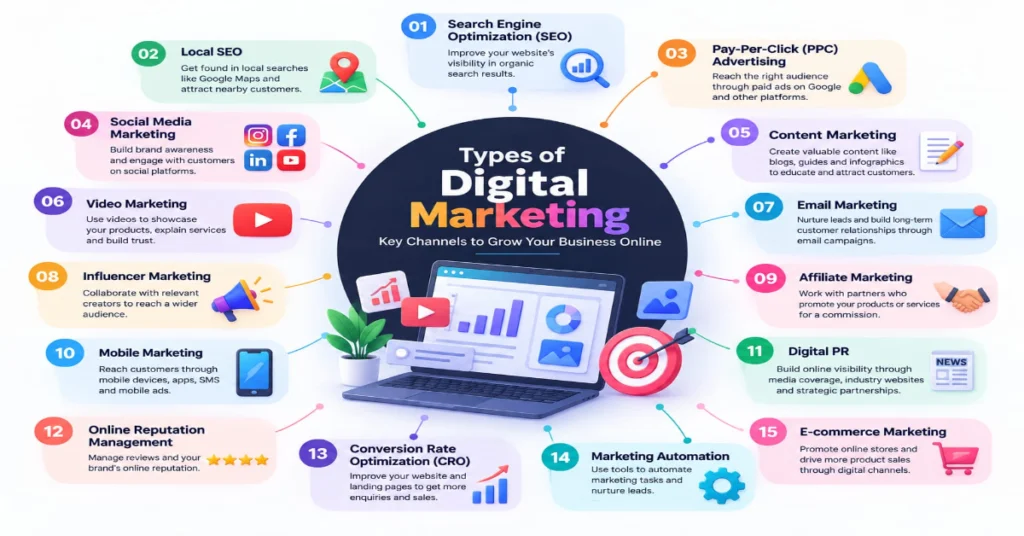
What Are the Different Types of Digital Marketing?
The main types of digital marketing include SEO (AEO, GEO), Local SEO, PPC advertising, social media marketing, content marketing, video marketing, email marketing, influencer marketing, affiliate marketing, mobile marketing, digital PR, online reputation management, conversion rate optimization, marketing automation, and e-commerce marketing.
Each channel serves a different purpose, and businesses can combine them based on their goals, audience, and budget.
Digital marketing includes the different methods businesses use to reach, engage, educate, convert, and retain customers through digital channels. The major types of digital marketing include:
- Search Engine Optimization (SEO)
- Local SEO
- Pay-Per-Click (PPC)
- Advertising
- Social Media Marketing
- Content Marketing
- Video Marketing
- Email Marketing
- Influencer Marketing
- Affiliate Marketing
- Mobile Marketing
- Digital PR
- Online Reputation Management
- Conversion Rate Optimization (CRO)
- Marketing Automation
- E-commerce Marketing
1.Search Engine Optimization (SEO)
Search Engine Optimization (SEO) is the process of improving a website so that search engines can better understand its content and potentially show its pages for relevant searches.
SEO can involve:
- Keyword research
- Search-intent analysis
- On-page SEO
- Technical SEO
- Content optimization
- Internal linking
- Image SEO
- Website performance
- Digital PR and relevant links
SEO is generally a long-term activity. Rankings and organic traffic can change based on competition, content quality, technical factors, authority, search demand, and many other signals.
When is SEO useful?
SEO can be particularly useful when customers actively use search engines to research problems, compare services, or find businesses.
2. Local SEO
Local SEO focuses on improving a business’s visibility for searches connected to a particular geographical area.
It is especially relevant for businesses that serve customers in specific locations.
Examples include:
- Restaurants
- Clinics
- Salons
- Hotels
- Real estate businesses
- Retail stores
- Educational institutions
- Professional services
- Local agencies
A key entity in local search is the Google Business Profile.A business can use its profile to provide information such as its business category, location, opening hours, website, phone number, photos, services, and customer reviews.
3. Pay-Per-Click (PPC) Advertising
Pay-Per-Click advertising, commonly called PPC, is a form of paid digital advertising.
Google Ads is one of the best-known PPC platforms.
Businesses can use paid search campaigns to appear when people search for relevant products or services.
For example:
“website design company in Kannur”
A website design company could create a Google Ads campaign targeting relevant searches and direct users to a dedicated landing page.
PPC can help businesses:
- Reach specific audiences
- Promote offers
- Generate leads
- Drive website traffic
- Test demand
- Support product launches
However, getting clicks isn’t enough.
A successful PPC campaign also depends on the relevance of the advertisement, landing page, offer, conversion process, and follow-up.
4. Social Media Marketing
Social Media Marketing uses social platforms to communicate with audiences, build communities, distribute content, and promote products or services.
Common platforms include:
- YouTube
- TikTok, where available and relevant
- Social media marketing can include:
- Organic posts
- Reels
- Stories
- Short-form videos
- Educational content
- Community engagement
- Influencer collaborations
- Paid social advertising
For example, a boutique can use Instagram to showcase new collections, styling ideas, customer experiences, behind-the-scenes content, and short-form videos.
The objective isn’t simply to post every day.
A useful social media strategy begins with:
Audience → Content → Platform → Action
5. Content Marketing
Content marketing involves creating and distributing useful content for a specific audience.
Content can include:
- Blog posts
- Guides
- Case studies
- Research
- Videos
- Infographics
- Checklists
- E-books
- Webinars
- Social media content
For example, instead of repeatedly promoting an SEO service, an agency could publish:
“Why Is My Website Not Ranking on Google?”
That article can help someone understand a problem before they decide whether they need professional SEO support.
Good content can also connect related topics.
For example:
SEO
→ Keyword Research
→ Technical SEO
→ On-Page SEO
→ Local SEO
→ Google Business Profile
→ Internal Linking
→ Search Console
This makes the information easier for users to navigate and understand.
6. Video Marketing
Video marketing uses video to communicate information, demonstrate products, explain services, tell stories, or build brand awareness.
Video can appear on:
- YouTube
- Websites
- Other video platforms
Examples include:
- Product demonstrations
- Tutorials
- Customer testimonials
- Explainer videos
- Reels
- Behind-the-scenes videos
- Educational videos
- Brand films
A business selling a complex service can often explain its value more clearly through a short demonstration than through several paragraphs of text.Video can also complement written content
7. Email Marketing
Email marketing uses email to communicate with prospects and existing customers.
Common uses include:
- Newsletters
- Product announcements
- Offers
- Educational content
- Lead nurturing
- Customer updates
- Event invitations
- Follow-up messages
For example, an e-commerce company could send an email when a new product collection launches.
A B2B company might send an educational guide to potential customers before following up with a sales conversation.
Email marketing becomes more useful when businesses segment audiences according to their interests, customer stage, or previous interactions.
8. Influencer Marketing
Influencer marketing involves working with creators or individuals who have an established audience.
An influencer might promote:
- A product
- A service
- An event
- A destination
- A brand campaign
For example, a beauty brand could collaborate with a beauty creator who has an audience interested in skincare.
However, the largest follower count doesn’t automatically mean the best campaign.
Businesses should consider:
- Audience relevance
- Location
- Engagement
- Content quality
- Brand fit
- Credibility
- Campaign objectives
For a local business, a smaller creator with a highly relevant local audience may be more appropriate than a large creator whose audience is spread across unrelated locations.
9. Affiliate Marketing
Affiliate marketing is a performance-based marketing model.
An affiliate promotes a company’s product or service and may receive a commission when a qualifying action occurs, according to the affiliate program’s terms.
The relationship can look like:
Business → Affiliate → Audience → Conversion
For example, a technology website might review a product and provide an affiliate link.
If a reader purchases through that link, the publisher may receive a commission.
Affiliate marketing is common in:
- E-commerce
- Software
- Technology
- Publishing
- Blogging
- Creator businesses
Trust is particularly important because audiences are more likely to act on recommendations they consider useful and credible.
10. Mobile Marketing
Mobile marketing focuses on reaching customers through mobile devices.
It can include:
- Mobile-optimized websites
- SMS marketing
- Mobile applications
- Push notifications
- Mobile advertising
- Location-based marketing
This is important because customers increasingly interact with businesses through smartphones.
For a local business, someone might discover a business through Google Search on a phone, view its location in Google Maps, visit its website, and contact it through WhatsApp.
That means the entire journey needs to work well on mobile.
11. Digital PR
Digital PR involves building online visibility and relationships through digital publications, media coverage, industry websites, creators, and other relevant online channels.
Digital PR can include:
- Online media coverage
- Expert contributions
- Digital publications
- Industry interviews
- Original research
- Data-led stories
- Relevant partnerships
For example, a Kerala-based digital marketing agency could publish research about the digital adoption of small businesses in Kerala and use the findings as a basis for legitimate industry coverage.
The value is not simply obtaining a link.
It can also be about brand visibility, credibility, relationships, and reaching relevant audiences.
12. Online Reputation Management
Online Reputation Management (ORM) focuses on monitoring and managing how a business is represented online.
This can involve:
- Customer reviews
- Business listings
- Brand mentions
- Social media conversations
- Search results
- Customer feedback
For a local business, reviews can play an important role in how potential customers evaluate the business.
A genuine review strategy should focus on providing a good customer experience and making it easy for real customers to share honest feedback.
Businesses should avoid creating fake reviews or manipulating ratings.
13. Conversion Rate Optimization (CRO)
Conversion Rate Optimization, or CRO, focuses on improving the percentage of website visitors who complete a desired action.
A conversion might be:
- Contact form submission
- Phone call
- WhatsApp enquiry
- Booking
- Purchase
- Quote request
- Newsletter signup
Imagine a website receives 1,000 visitors but only 5 people enquire.
Increasing traffic isn’t necessarily the only solution.
The business might need to examine:
- Page messaging
- CTA placement
- Forms
- Trust signals
- Website speed
- Mobile experience
- Pricing information
- Landing-page relevance
CRO therefore connects traffic with business outcomes.
14. Marketing Automation
Marketing automation uses software and predefined workflows to automate certain marketing activities.
Examples include:
- Automated email sequences
- Lead nurturing
- Customer follow-ups
- Lead scoring
- Campaign workflows
- Notifications
For example:
Website form submission
↓
Lead enters CRM
↓
Welcome email
↓
Follow-up
↓
Sales team notification
Automation can save time, but it shouldn’t replace relevant communication.
15. E-commerce Marketing
E-commerce marketing focuses on promoting products and generating online sales.
It can combine several digital marketing channels:
SEO
→ Product and category visibility
PPC
→ Paid product promotion
Social Media
→ Product discovery
Influencer Marketing
→ Product recommendations
→ Customer retention
Content
→ Product education
CRO
→ Better purchasing experience
This illustrates an important point:
Digital marketing channels don’t have to compete with each other. They can work together.